
Capability statements & buyer decisions · 5 min read
Capability statement examples: turn your service list into a buyer’s reason to choose
By Annie S Pathania, Brand & Growth Strategist
You have listed the services, added the logo and made the deck look professional. Now ask the harder question: does it explain why this particular buyer should choose you?
The examples below are illustrative writing exercises, not client stories or claims of results. Use them to shape your own message, and only include evidence your business can substantiate.
Example one: a tender or supplier-panel introduction
A generic opening might say: ‘We provide a wide range of high-quality services.’ It leaves the evaluator to work out the fit.
A more focused structure is: ‘We help [buyer type] deliver [required work], with [relevant capability] and [verifiable evidence].’ Replace every bracket with a specific, true answer. Then map the detail to the opportunity’s requirements.
Choose evidence that supports the actual requirement: relevant qualifications, a documented process or an approved example of comparable work. Do not substitute an attractive deck for the requested response.
Example two: a distribution or strategic-partner conversation
A partner needs more than a description of your product. Your statement should explain who it serves, how it complements their offer and what working together would involve.
Try: ‘Our [offer] helps [shared audience] with [specific need]. For a partner serving that audience, we propose [clear arrangement], supported by [verified delivery capability].’ Do not imply an agreed partnership, endorsement or commercial result that does not exist.
Example three: a consumer brand pitching a stockist
Selling to consumers does not remove the need for B2B communication. A stockist is making a business decision about carrying your offer.
Explain the customer fit, the product range and how supply would work. Separate your customer-facing brand story from the information a buyer needs to evaluate the relationship. Include pricing, terms or product evidence only where appropriate for that conversation.
What should change between versions?
- The opening: name the buyer’s relevant need, not your whole business history.
- The capabilities: lead with the ones this opportunity requires.
- The evidence: match each important claim with a checkable source or permitted proof.
- The next step: make the proposed conversation or decision clear.
A quick check before you send it
- Can a reader explain who you help and why you fit this opportunity?
- Could a competitor use the same opening unchanged? If so, make it more specific.
- Have you checked permissions for every logo, quote and result?
- Does it meet the buyer’s format and information requirements?
- Are your contact details and next step easy to find?
Start with the finished template, not a blank slide
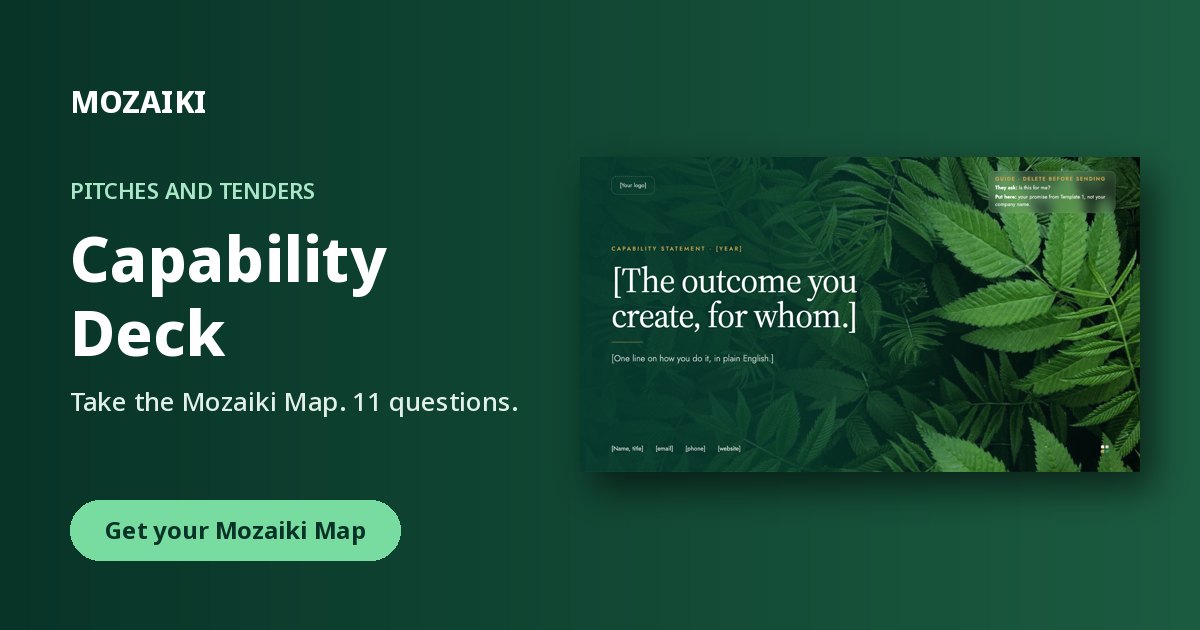
The Mozaiki Capability Deck Template is already designed and structured. It includes editable slides, icons and royalty-free dividers. Make your own Google Slides copy, then adapt the content or download it as PowerPoint.
Use the template to organise the case, not to invent one. If the reason to choose you remains unclear, the Mozaiki Map is a useful next step before you polish the deck.
Keep reading
- Capability statement: a practical guide and editable PowerPoint template
- Brand strategy in Sydney: how to choose a brand strategist and what to expect
Let’s talk.
You’ve got a business to grow. Let’s talk about what’s getting in the way. In 30 minutes, we’ll look at where you are, what you’re working towards and where a clearer approach will make a difference. If you’ve completed the Mozaiki Map, bring your results. We’ll use them to guide the conversation.
Apply for an intro callNot sure what your point of difference is yet?
The Mozaiki Map takes a few minutes and shows where your positioning is strong and where it needs work, before you write a word.
Get your Mozaiki Map