
Tenders, pitches & partners · 7 min read
Capability statement: a practical guide and editable PowerPoint template
By Annie S Pathania, Brand & Growth Strategist
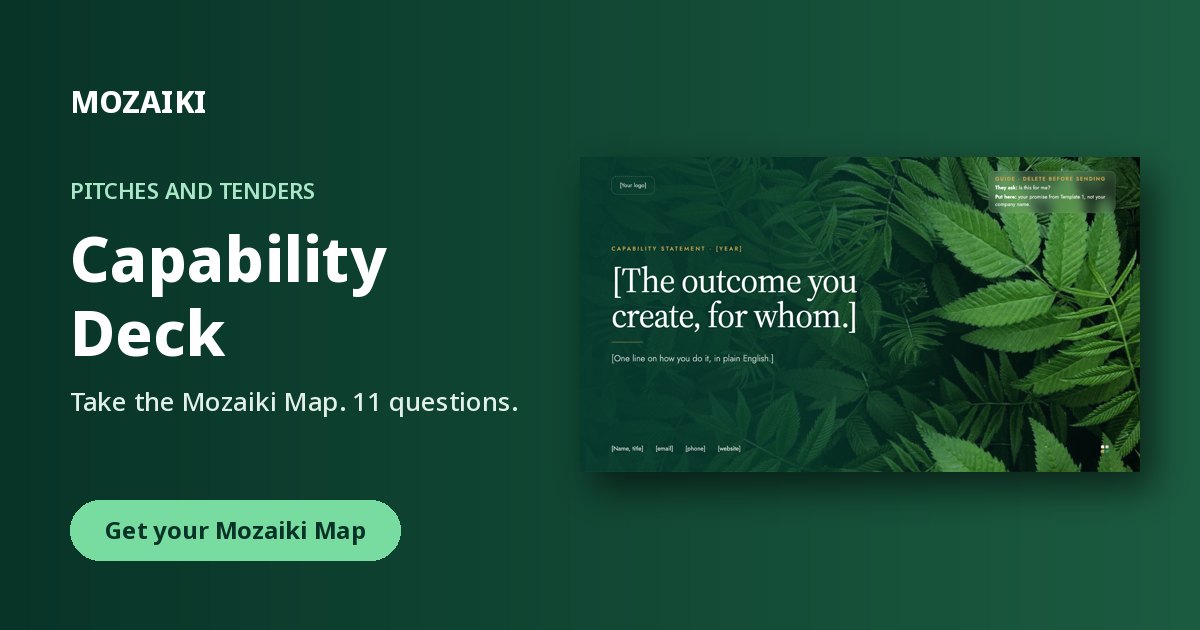
A capability statement should do more than describe your business. It should help someone else decide whether your capability fits the opportunity. A clear document cannot guarantee a shortlist, but it can make your case easier to assess.
A procurement panel, a retail buyer or a prospective partner is usually comparing you with several others, often quickly. Your capability statement has one job: make choosing you feel like the safe, obvious decision.
What a capability statement actually is
A capability statement is a short, structured document that explains what your business does, who it does it for, how it delivers and why it can be trusted. It is commonly requested in government and corporate tenders, supplier panels and partnership conversations.
Think of it as the brief someone else uses to argue for you in a room you are not in. If they cannot repeat your value in a sentence, the document has not done its job.
Why so many get passed over
- They open with history, not with the buyer’s problem.
- They list every service instead of the few that matter for this opportunity.
- They claim quality without showing evidence, process or credentials.
- They look like every other supplier, so price becomes the only difference.
- They are hard to scan, so evaluators miss the strongest points.
The structure that works
Use this order. Each section answers a question the evaluator is already asking.
- Who we help and the problem we solve: one clear sentence, in the buyer’s words.
- Core capabilities: three to five, matched to what this buyer needs.
- Why us: your point of difference, said plainly, not a list of adjectives.
- How we deliver: your process, so the buyer can picture working with you.
- Proof: credentials, accreditations, approved results and relevant experience.
- Business details: company information, codes or registrations the buyer requires.
- Next step and contact: make it easy to take the conversation forward.
Not just for tenders: why consumer brands need one too
If you sell directly to customers, it is easy to assume a capability statement is not for you. But the moment you pitch a stockist, a retail buyer, a distributor, an association, a bank panel or a corporate partner, you are in a business-to-business conversation.
Those buyers are not asking whether they like your product. They are asking whether you are a reliable partner, whether you will make them look good, and whether you can deliver at their scale. A well-built capability deck answers those questions before they are asked.
Positioning comes before the page
The hardest part of a capability statement is not the layout. It is deciding who you are for and why they would choose you. If that decision has not been made, no template will fix it, and the document will drift back into a list of services.
That is why we start with the decision, not the deck. Get clear on your position first, then the capability statement almost writes itself.
Capability statement or tender response?
Treat your capability statement as an introduction to your business, not a substitute for a tender response. For a specific tender, follow the supplied instructions, address each requirement and use the requested format. A polished presentation does not replace a missing answer.
Keep a master deck, then tailor a copy for each opportunity. Put the buyer’s priorities first, remove irrelevant capabilities and check that every claim has evidence you are allowed to share.
Use the editable template
The Mozaiki Capability Deck Template is a fully editable presentation built on this structure. It includes a best-practice layout, icons and royalty-free section dividers, so you can focus on your content rather than the design.
Make your own copy in Google Slides, or download it as a PowerPoint file from the File menu. Adapt it for each tender, buyer or partner you approach.
Keep reading
- Capability statement examples: turn your service list into a buyer’s reason to choose
- Brand strategy in Sydney: how to choose a brand strategist and what to expect
Let’s talk.
You’ve got a business to grow. Let’s talk about what’s getting in the way. In 30 minutes, we’ll look at where you are, what you’re working towards and where a clearer approach will make a difference. If you’ve completed the Mozaiki Map, bring your results. We’ll use them to guide the conversation.
Apply for an intro callNot sure what your point of difference is yet?
The Mozaiki Map takes a few minutes and shows where your positioning is strong and where it needs work, before you write a word.
Get your Mozaiki Map