
Tenders, pitches & partners · 4 min read
The 5 slides evaluators actually score in a capability deck
By Annie S Pathania, Brand & Growth Strategist
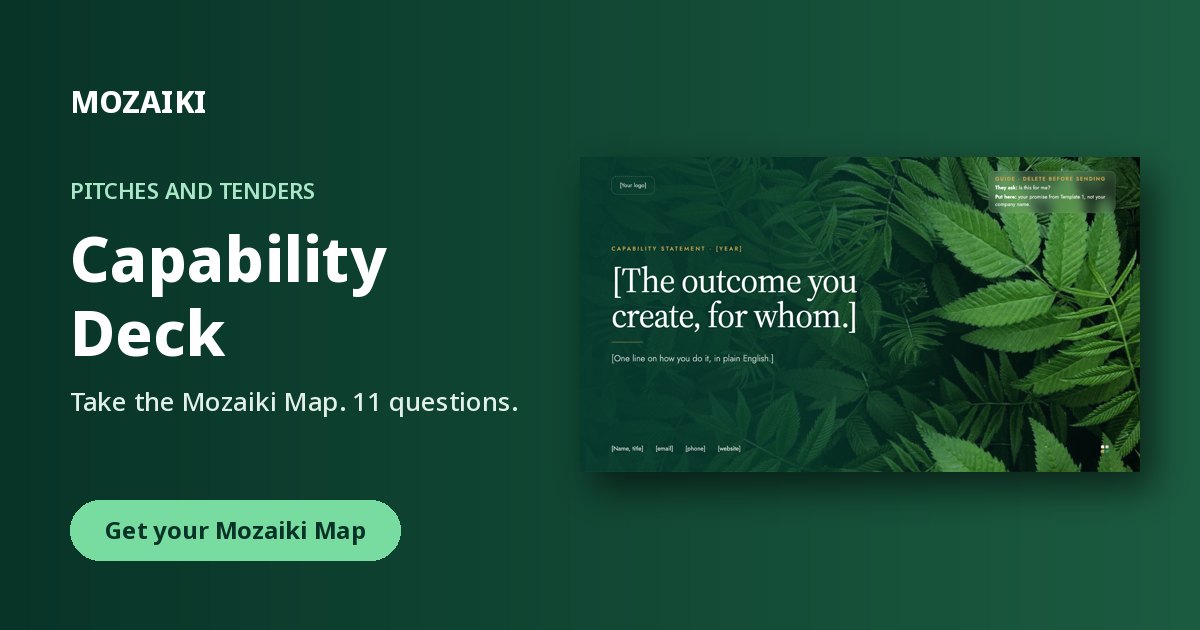
Most capability decks are written to impress. The ones that win are written to be scored.
A brochure says: here is everything we can do. An evaluation deck says: here is the answer to the question you are scoring. The brochure asks the panel to do the work. They won’t. They have a stack of submissions and a deadline.
Slide 1: The answer up front
One sentence on why you, for this buyer, for this brief. If the panel reads nothing else, they should still know why you fit.
Slide 2: Their problem in their words
Mirror the brief. Use the buyer’s language and priorities, and show you understood before you explain anything about yourself.
Slide 3: Proof they can tick
Outcomes, credentials and relevant experience, mapped to the criteria. One claim per point, each with evidence you are allowed to share.
Slide 4: How it will work
Approach, team and timing. The goal is to lower perceived risk, so the buyer can picture working with you without guessing.
Slide 5: Why you over the others
The difference only you can claim. If a competitor could paste the same sentence into their deck, keep refining it.
Three shifts that change how a deck reads
- Lead with their criteria, not your history.
- Prove one thing per slide, with evidence they can tick.
- Say why you, in one sentence, before page two.
If your deck could belong to any capable firm
It will be scored like any capable firm. That is usually a positioning question, not a design one. The Mozaiki Map helps you find the decision underneath, and the editable 13-slide Capability Deck template comes with your result.
Keep reading
- Capability statement: a practical guide and editable PowerPoint template
- Capability statement examples: turn your service list into a buyer’s reason to choose
Let’s talk.
You’ve got a business to grow. Let’s talk about what’s getting in the way. In 30 minutes, we’ll look at where you are, what you’re working towards and where a clearer approach will make a difference. If you’ve completed the Mozaiki Map, bring your results. We’ll use them to guide the conversation.
Apply for an intro callNot sure what your point of difference is yet?
The Mozaiki Map takes a few minutes and shows where your positioning is strong and where it needs work, before you write a word.
Get your Mozaiki Map